Stories
How U!REKA turns an idea into a high-impact collaboration.
The collaboration between Frankfurt University of Applied Sciences and HOGENT centres on the Grey Energy Atlas (GrEAt!), a research and teaching project led by Florian Mähl that maps and evaluates the environmental quality of the materials used in existing buildings. “The buildings are analysed on the basis of their embodied energy and the associated greenhouse gas emissions. This provides insight into the environmental impacts throughout the entire life cycle – from construction to the current state – and enables an assessment of their ecological value. This should then lead to sustainable and well-informed construction and renovation decisions,” explains Florian.
At the same time, GrEAt! serves as an innovative project in which education, research and international cooperation go hand in hand. That international approach was important to Florian: “It certainly adds value to the project that the theory and tools I have developed also work in other contexts and countries, sometimes with different criteria. Moreover, the subject matter is international: sustainability and climate issues do not stop at national borders.”
Students as research assistants
Students from Frankfurt and HOGENT gained practical insight into the challenges of sustainable architecture and set to work addressing them. For example, during the first semester of the 2025–2026 academic year, eight final-year real estate students at HOGENT analysed a building on HOGENT’s largest campus as part of their practical study (an alternative to the traditional bachelor’s thesis). They based their work on the findings and tools provided to them by Florian Mähl and presented their results in January 2026. The students’ findings have been incorporated into the GrEAt! project and can be found on the website, where they are listed as research collaborators.
The added value of U!REKA
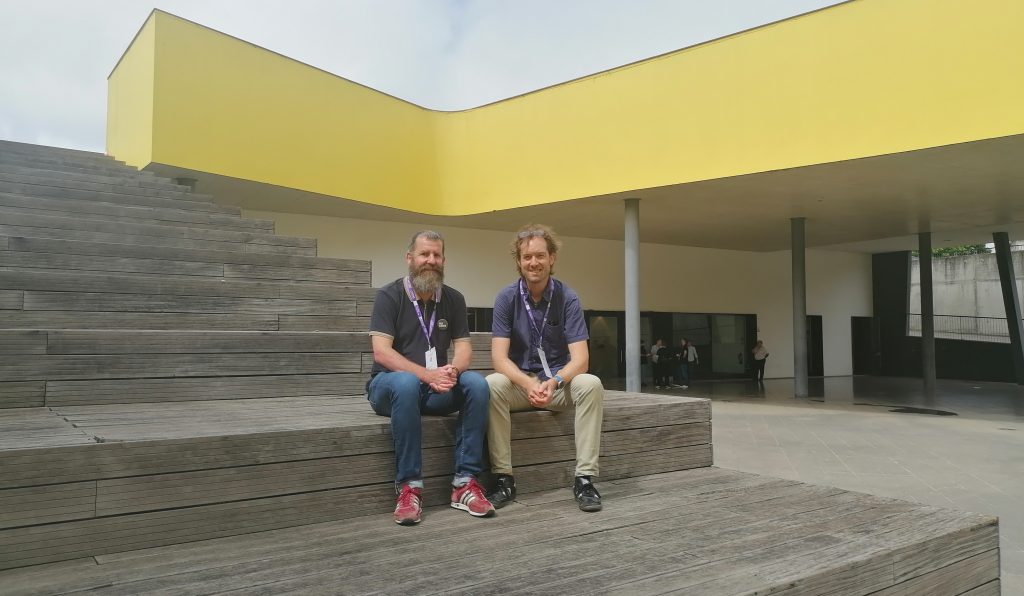
This collaboration is a great example of the strength of the U!REKA partnership: Bjorn De Rouck and Mieke Paelinck, Head of the Built Environment Department (of which the property programme forms part), met Florian Mähl at U!REKA Connects in Ostrava and immediately recognised the added value his research project would bring to their programmes.
One thing led to another, and a year and a half later, the German professor gave an open guest lecture at HOGENT – attended by over 250 people – and held an information session for final-year real estate students, during which Florian Mähl explained his research and the groundwork for further collaboration was laid. Eight students expressed an interest and committed to this pathway as part of their practical study.
According to Bjorn De Rouck, this project is a textbook example of just how significant U!REKA’s impact can be: “What began two years ago as a rather coincidental meeting in Ostrava resulted in a collaboration is led to an adaptation of our curriculum, an expansion of our expertise – our knowledge of grey energy had previously been limited – as well as international experience and valuable recognition for our students. Furthermore, we are now working on further and more structured collaboration.”
A real asset on your CV
One of the HOGENT students taking part in the programme was Ruben De Smedt. For him, it was a (deliberate) step outside his comfort zone. The ‘grey energy’ project immediately caught his interest: “I prefer to delve into the regulatory and sustainability aspects of the sector rather than the commercial sales side of real estate, so this project was a perfect fit with my interests.”
Ruben describes the programme with Florian Mähl as quite intensive. “The lecturer was in Ghent for a few theory lessons and practical measurements at Building B on the Schoonmeersen Campus. It was conducted entirely in English. It also gave me an insight into the different approaches to the field: whilst HOGENT focuses on real estate management, the partner institution in Frankfurt tends to look at it from an architectural and scientific perspective.”
For Ruben, it’s clear: “This international exchange provided me with practical knowledge that I wouldn’t otherwise have gained. I learnt to look at the life cycle of buildings in a different way: not just focusing on the construction itself, but also on the amount of energy embodied in materials for new-builds compared to renovations. I regard this expertise as a major asset on my CV,” he concludes.