Stories
The U!REKA Lab: Urban Commons: creating breeding ground for cities of the future
There are a lot of reasons why ‘urban commons’ are a connecting theme for the U!REKA institutions. All partners are located in and linked to urban areas that face complex urban challenges – social, spatial, environmental, etc. – and are looking for ways to find sustainable solutions.
The U!REKA Lab: Urban Commons is a living lab, which means that it offers a space, physical or virtual, in which social challenges can be solved by bringing together various stakeholders for collaboration, and by the collective development of ideas and activities.
Bottom-up
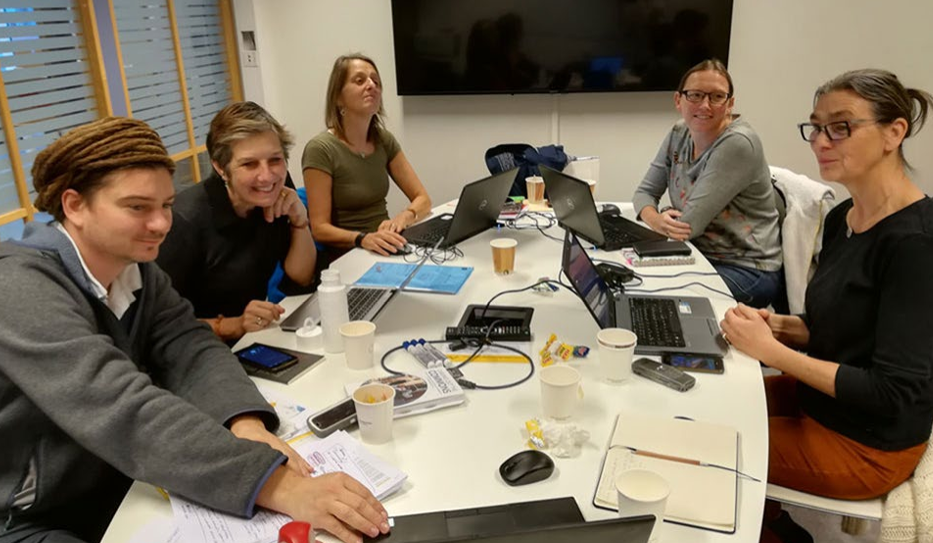
Raul Gschrey (Frankfurt UAS), who is one of the initiators, explains: “We are working towards an innovative and participatory collaborative educational agenda that includes students, teachers and urban communities in a process of common knowledge creation and analysis. Project and research based methods form the basis of this international and interdisciplinary collaboration.
According to Raul, one of the strong characteristics of Urban Commons is the bottom-up approach: “We start creating a project to tackle an urban challenge – e.g. a livable city – by bringing together different disciplines, knowledge and expertise: engineers, economists, environmentalists, artists, etc. These different disciplines and angles create a breeding ground on a challenge based paradigm.”
Courses
The heart of the U!REKA Lab: Urban Commons are annual blended U!RBAN Commons Courses accompanied by teacher visits, short-term online and live exchanges. The courses aim to include the actors and local commoners in a co-creative process of knowledge creation. The overall goal is to compare different co-creation approaches and concrete examples in each country and form a more holistic view of what urban commons can contribute to the cities of the future: from social life and culture to mobility, healthcare and welfare, climate change and housing.
During the U!RBAN Commons Courses, the local student groups of the participating institutions are studying the theoretical framework of urban commons as well as actual urban commons initiatives. Students propose plans and solutions for strengthening the commons in collaboration with the communities.
“The students involved often are very enthusiastic, because they feel they’re contributing to something very tangible. They experience that they really can have a positive impact on society, that that can change things”, says Angelika Plümmer, lecturer in Frankfurt UAS and involved in Urban Commons.
By working on common research questions internationally, students and staff built a joint knowledge-creating community. As a result of the accumulating research insights over the years different categories of urban commons were established:
- Planning & Governance
- Mobility & Technology
- Socio-Culture
- Housing & Inclusion
- Ecology & Environment
Hurdles
To get to this point, The U!REKA Lab: Urban Commons wasn’t always a walk in the park. It experienced from the beginning quite some practical hurdles an international collaboration often is confronted with: the very first activity – already in 2020 – was a shared study module on urban commons. This was integrated into existing courses. The practical reason for this way of working was that the semesters of het U! partner institutions start and end in such different timeslots that establishing a simultaneous course would have been almost impossible. On top of that, there was the COVID-19 pandemic, that hit right at the time the joint teaching started.
“But, since we were used to meet and share ideas online by that time, we in some way were prepared for this challenge”, explains Raul Gschrey. “Furthermore, focusing on virtual teaching and learning instead of physical mobility made our activities environmental friendly and created virtual mobility across Europe.
European University Alliance
So for the U!REKA Lab: Urban Commons the pandemic was a major challenge, but not a real gamechanger. The same thing can be claimed about the recognition of U!REKA as a European University Alliance: getting European funding implied setting clear targets and a lot of reporting and deliverables, aspects that felt a bit unnatural to the Urban Commons approach.
Raul Gschrey admits this more structured way of working and the administrative follow-up are limitations to the organic Urban Commons way of working. But at the same time, it offers a lot of advantages. Apart from more budget, the U!REKA European University led to a more international mindset: more teachers, researchers and staff are interested in international collaboration. “So it enhanced chances of new bottom-up initiatives”, Raul concludes.
More information
The online platform urcommons.eu is the digital heart of the Lab. It reports on the activities within the network and facilitates international exchanges across universities and courses. Learning materials, recordings of the U!R Commons Lecture Series, lecture scripts and presentations are publicly accessible, according to the commons principle. They can be used by the participants and other interested organisations.