Stories
U!REKA’s midterm: what has been achieved so far.
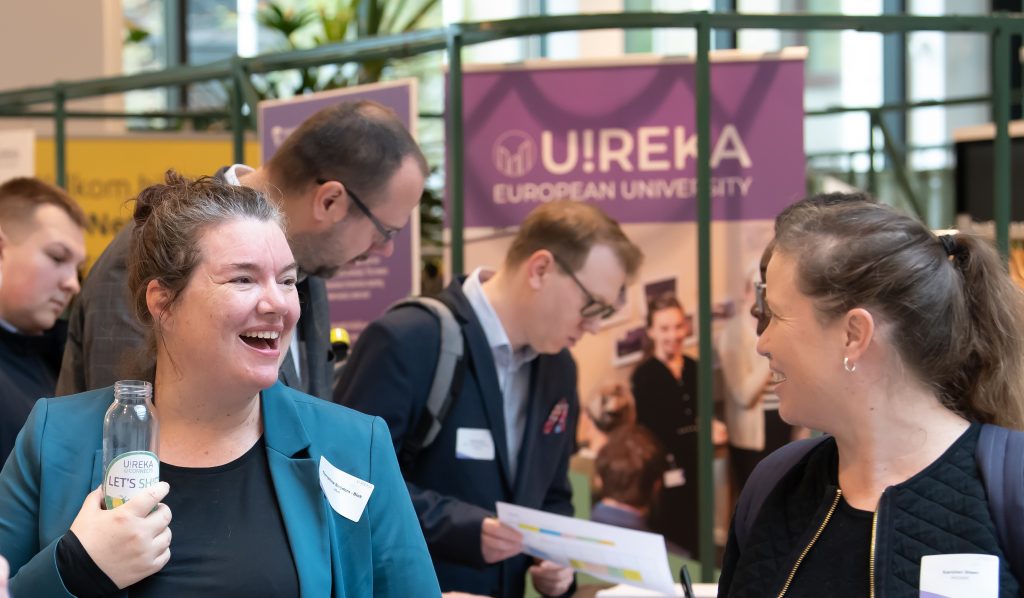
The U!REKA rectors gathered on 11-12 March in Frankfurt for a strategic workshop to design U!REKA European University 2.0 and to attend a meeting of the Steering Committee where, between other topics, the midterm review was discussed, focusing on project achievements, financial monitoring, key performance indicators, and priorities for the next phase, including scaling education and ensuring sustainability.
In terms of education, U!REKA created an open online campus, with more than 50 open courses for U!REKA-students, related to green and digital transition and transversal skills. About 25 blended intensive programmes (BIP) were organized, as well as 14 collaborative online international learning projects (COIL) and 3 co-developed courses. All partner institutions are currently integrating a joint sustainability course in their curriculum.
Next to these initiatives a pedagogical framework and joint staff trainings with 2200 participants are established.
Research for sustainable future
What concerns research, U!REKA established 3 Centres of Expertise developing a joint research agenda, projects and solutions to accelerate the transition towards smart and sustainable cities:
- Climate-Neutral Urban Communities
- Transition to Circular Society
- Innovative Governance Models & Citizen Engagement
On top of that, 10 U!REKA EU projects are awarded and ongoing.
Solutions for real-life challenges
Through multidisciplinary education and hands-on projects, U!REKA created so far 50 new solutions to address issues like digitalisation to societal inequalities, climate change and environmental degradation. These solutions were created in projects, hackathons, and joint courses between students, experts and partners (in projects, hackathons and joint courses).
Internally, the alliance built governance infrastructures, with strong collaboration among staff and students and increased European visibility. The next steps include scaling up the joint course development, increasing student mobility, delivering tangible impact through continuous collaboration between eachother and with our stakeholders.